Wednesday, 1 April 2020

MASS EXODUS IN HISTORY


BY APURVA RAI
THE second decade of the 21st century has seen an unprecedented event; you may call it a scare, you may call it a pandemic or you may even call it a war or a biological war, to be precise. The entire world is fighting an unseen enemy, coming from the Wuhan province of China, posing danger to human lives all across the globe. Every single person on earth today lives in fear, feels threatened, finds himself helpless to the wrath of nature and runs away from even his near and dear ones to run for his life. The enemy, which crosses the boundaries and lines of control of all nations without fear, passport or visa, seems invincible.

The enemy, which poses danger to the entire human race, has challenged all progress, developments and technological advancements that the modern world has made. The enemy number one to mankind today is known by the name of Corona Virus or Covid 19. 

Corona has brought the entire world to a standstill-- all offices shut, factories closed and shops forced to bring down shutters. Almost every country is in a state of health emergency with complete lockdown and full restriction on human movement. You stay where you are, but, stay away from all others, no matter if they are your friends, family or relatives. The idiom 'Proximity breeds contempt' may be revised as 'Proximity breeds disease' in today's global scenario. 

In India, too, a 21-day complete lockdown was declared on March 25, 2020 by the Union government led by Prime Minister Narendra Modi. Nobody was allowed to go anywhere as rail, road and air traffic was completely shut. Highways were closed for vehicles, trains halted and flights grounded-- everyone was stuck where he or she was. The fast paced life in the cities of Delhi/NCR, Mumbai, Pune and Bengaluru suddenly came to a halt forcing people to stay indoors and work from home, wherever possible. The people were asked to stay indoors and get groceries delivered at their doorstep. 

But the facts of life are different-- not everyone can work from home. Thousands of labourers and other workers were suddenly left with no work, no income, no earnings yet all expenses intact. Millions lost work overnight. There was panic and a large number of them rolled their beds, packed their bags, took their families and set out for their hometowns. Yes, they all started trekking under scorching sun in the absence of any conveyance. All appeals to stop them fell on deaf ears.The distance to be covered ranged between 100 kilometres to a thousand kilometres without any means of transport or food for the children. Still they were willing to traverse and prepared to face any amount of hardship that would come their way. 


Within a day of lockdown India was witnessing a massive exodus from metropolitan cities to the hometowns. The migrants were seen in the states of Maharashtra, Rajasthan, Delhi/NCR. The entire purpose of lockdown, to implement social distancing, stood defeated. Migrants were on road, carrying their belongings on their heads, beating social distancing, hunger and starvation, facing hardships together. They started walking all their way to their hometowns, mostly in Uttar Pradesh, Bihar or Rajasthan.

India had never seen such a mass migration of human population in the 21st century; it was, perhaps, the first for many of us. Delhi's bus terminus at Anand Vihar became assembly point for lakhs of such migrants where the state governments arranged several buses to ferry these workers so that they do not have to walk.  Arrangements, however, did not seem sufficient and thousands of these workers stood in despair waiting to get a vehicle for their home.

Complete chaos at the bus terminus, assembly of people in large numbers and walking on foot together only increased the chances of corona virus infection. People risked their lives as they saw no hope. Many felt even if corona virus does not kill them they will die of hunger and starvation.

Corona made the modern day life difficult be it the people following social distancing to break the chain of virus from spreading or others who fought for their existence every day. Modern India was facing mass exodus in the most primitive manner. It was like history repeating itself when the world had witnessed similar mass migrations on several occasions at different times.

Come, let us recall some of the mass migrations that the world has seen before, including India.

What is Mass Exodus
This means migration of large groups of people from one geographical area to another. This, however, does not include seasonal migration, which may occur on a regular basis. 

Causes of Mass Migration
The reason for migrating are complex but people usually flee from their home due to war, persecution, climate crisis, water degradation, land rush, crime rate and food poverty. Today it would be apt to refer to an epidemic or pandemic too as one of the causes of mass migration.

IN INDIA...
It is not for the first time that India has seen mass migration. The first was at the time of Independence when India was divided into West Pakistan which is commonly referred as Pakistan and East Pakistan which is now known as Bangladesh. The mass migration was witnessed when people shifted from India to Pakistan and vice versa. 

1) India's Partition: Following the partition of British India into Pakistan and India, some 15 million people found themselves stranded in the 'wrong' part of the land, Hindus in Pakistani territory and Muslims in Indian territory. Thus began the greatest international migration in history with Muslims migrating towards eastern and western wings of the newly formed state of Pakistan and Hindus crossing over to India. 

Emotions ran high and terrible atrocities were committed on both sides ranging from damage to property, arson, killing and mob violence. Ordinary peace loving Hindus and Muslims became so enraged with each other that they committed such atrocities they would never have considered themselves capable off.

UNHCR estimates 20 million Hindus, Sikhs and Muslims were displaced during the partition of India, the largest mass migration in human history.

2) Exodus of Kashmiri Pandits: The Hindus (also known as Pandits) of the Kashmir Valley, were forced to flee the Kashmir valley as a result of being targeted by JKLF and Islamist insurgents like Hizb-ul Mujahideen during late 1989 and early 1990. Of the approximately 300,000 to 600,000 Hindus living in the Kashmir Valley in 1990 only 2,000–3,000 remained there in 2016. 

Inflammatory speeches were made from loudspeakers of mosques and posters were stuck on the houses and shops of Kashmiri Pandits ordering them to either embrace Islam or leave the valley. They were threatened with their lives.

January 19, 1990, is widely remembered by Kashmiri Hindus as the tragic "Exodus Day" of being forced out of Kashmir. Most families were resettled in Jammu, Delhi/ NCR and other neighbouring states.


What happened on January 19, 1990: A curfew was imposed by the then governor, Jagmohan after he had dismissed the state government. Militant groups JKLF and Hizb-ul Mujahideen were exhorting people to defy the curfew.

Inflammatory slogans were relayed from mosques all day long. One of them said: ‘Kashmi mei agar rehna hai, Allah-O-Akbar Kehna hai’.

Kashmiri Pandits are known for their significant contributions to a variety of spheres, including Shaivism, philosophy, theology, literature and poetry, music, and the arts and sciences.

... AND THE WORLD

Apart from India several nations in the world have also witnessed mass exodus due to various factors. A 'second look' at some of them.

1) Great Atlantic Migration: The largest migration in history was the so-called Great Atlantic Migration from Europe to North America, the first major wave of which began in the 1840s with mass movements from Ireland and Germany.

2) Italian Diaspora: The Italian Diaspora refers to large-scale emigration of Italians from Italy. There are two major Italian diasporas-- the first  began around 1880, two decades after the Unification of Italy, and ended in the 1920s to early-1940s with the rise of Fascism in Italy. The second started after the end of World War II and roughly concluded in the 1970s. According to an estimate between 1880-1980, about 15,000,000 Italians left the country permanently. 

Poverty was the main reason for leaving, specifically the lack of land as property became subdivided over generations; especially in the South of Italy. Secondary reasons were internal political and economic crisis, organized crime and difficulties in the former Kingdom of the two Sicilies. 


3) Migration in America: The United States of America experienced a wave of mass migration like never before from 1850 to 1920. Between 1880 and 1914, over 20 million Europeans migrated to the US, at a time when the country only had 75 million residents.

According to a study, "In 1850, at the onset of the Age of Mass Migration, over 90 percent of the foreign born living in the US were from either Great Britain, Ireland, or Germany. By the end of the Age of Mass Migration, in 1920, this figure was only 45." 
It was one of the greatest migrations in human history. From 1846 to 1940, about 55 million Europeans migrated to the United States and South America seeking a better life. The result was that the governments in Europe from Vienna to Prague came out with strong messages and punishment to prevent the spread of the so-called 'America Fever'.

4) Great Migration: The United States not only witnessed mass migration from different nations, mainly Europe, it also saw internal migration which occurred during the industrial revolution. According to some estimates over a 60 year period, from 1910 to around 1970, more than seven million African Americans moved from rural areas in the US, to settle in the more industrialized cities located in the Midwest and Western regions.
Due to the massive number of people involved in the migration, historians refer to the phenomenon as the Great Migration.

5) Resettlement of Europe after Soviet Domination: At the end of World War II changes in the map of Europe meant that many people found themselves living in hostile territory. Majority of these people were Germans who were expelled, evacuated or fled from Central and Eastern Europe to the new Germany. This evacuation is known as the largest single instance of ethnic cleansing in recorded history.

6) Potsdam Agreement: This agreement was signed by the victorious nation at the end of  World War II. The agreement led to one of the largest migrations, involving almost two crore people, ever witnessed within Europe's borders.

One of the communities that were significantly affected was the Germans living in Eastern Europe. Estimates indicate that more than 16,000,000 Germans were forced to move from nations in Eastern and Central Europe back to their native home in Germany.

7) Russian Civil War: The period of this war is described from November 1917 to October 1922. It was one of the bloodiest war in Russia's history as it resulted in the death of close to 8,000,000 people according to some estimates. 

To escape the bloodshed, more than 3,000,000 people fled from Russia. Some of the communities that fled the nation were the Poles, the Russians, and the Germans.

The civil war occurred because after November 1917 many groups had formed that opposed Lenin’s Bolsheviks. These groups included monarchists, militarists, and, for a short time, foreign nations and they were collectively known as the Whites. Te Bolsheviks, on the other hand, were known as the Reds. 

The Red Army won this war because it was better-organized and held the best territory. After this war, the communists established the Soviet Union in 1922. 

8) From Rural China to Urban Centers: Grinding poverty was always a problem for rural China. During the regime of Mao Zedong rural population was not allowed to migrate to urban areas. In 1982 the people's communes were dissolved which led to mass exodus of hundreds of millions of people from China’s countryside to its fast-growing cities. In 1984 permission was given to peasants to move to towns of 100,000 inhabitants or less. Thus China saw creation of surplus labour. 

Since then Urban population in China has increased enormously helping the country to strengthen its economy. 

**********************

NOTE:
Read my another article in Hindi on Corona virus.

Copy/ paste following link.

1) फासलों के दरमियां
https://apurvarai.blogspot.com/2020/04/blog-post.html


***********************

 2) ठहरे कदम !
https://apurvarai.blogspot.com/2020/04/blog-post_17.html


**************************

3) स्वाद का लॉकडाउन
https://apurvarai.blogspot.com/2020/04/blog-post_28.html


4) Lockdown Changes Life & Style
https://apurvaopinion.blogspot.com/2020/05/lockdown-changes-life-style.html


Tuesday, 18 February 2020

BECOMING KEJRIWAL !


BY APURVA RAI
THE Aam Admi Party (AAP) leader Arvind Kejriwal has now become the chief minister of Delhi for the third time in a row, though, it will be his second full length term to serve the people of the national capital; first one being a short-lived tenure which led to re-elections and  a record-breaking victory for the newest party foraying into Indian politics.


Lucky man he is as it is not a mean task to rise above the rest and rule with huge mandate in the national capital of Delhi; a city comprising of people from all sections of society, different cultures and religions, varied age-groups, rich, poor, intellectuals, service class, business class, politicians, famous and not so famous to aam admi living a quiet life with his family. 

You can influence one and impress some but cannot win everyone's heart. Arvind Kejriwal did exactly the same and that is why he stands out amongst hordes of politicians in India who are fighting and struggling everyday to get into the seat of power somehow. Arvind Kejriwal stands out because he never showed greed for power under the guise of doing social work or talking development or made promises which cannot be fulfilled or drew the picture of a rosy life for the aam admi of Delhi. He proved that he is one amongst us and is in public life to serve the people and not to enjoy the privileges of power. It was his honesty of thoughts and spirit of struggle that touched the hearts of people and they voted him to victory with such a margin that even the most veteran politician can only dream of. 

No doubt, the thumping victory is 'AAP's Pride, Opposition's Envy'.

WHAT MAKES KEJRIWAL A WINNER
The thumping victory of AAm Admi Party, led by Arvind Kejriwal has a lesson to teach other politicians, particularly the Congress which ruled the national capital for continuous 15 years in from 1998 to 2013. The entire credit for three terms that the Congress completed goes to chief minister late Sheila Dikshit. The public mood saw a change as Kejriwal prepared himself to take on the  bigger challenge with a few initial hiccups which were strong enough to shake, demoralise and diminish anyone else. 

The activist from India Against Corruption was standing on the threshold of Indian politics with a determination to stay and prove that one need not be a veteran politician-- a bundle of controversial statements, unabated comments, tall promises, false dreams, hate speeches and boring personality. In the muck that Indian politics is Kejriwal emerged as a 'lotus' of hopes for crores of aam admi residing in Delhi. Everyone voted for him wholeheartedly and the rest is history now. Soon after the results were declared Kejriwal lost no time in coming out and return public support by saying "Dilliwalon, gajab kar diya apne... I love you.." Delhi-ites were floored ! Wish Modi takes a lesson from him and reiterates the golden words for the public mandate he got in 2019.


What was the secret of Kejriwal's success? Honesty is the one word to describe him. The chief minister showed honesty of thoughts, honesty in his character, honesty in his words, honesty in his statements, honesty in his karma and presented an honest personality with clean image.  Enough reasons for aam admi to judge him and elect him. After all the new age voters are wise, educated and decisive. People find him different from other netas and a cut above the rest in Indian politics which rarely sees a clean image. 

Unlike other politicians Kejriwal never made hate speeches, never involved himself in mud-slinging and showed that he means business when he is in the seat of power. Indeed, a great lesson for all veteran politicians. 

Kejriwal's educational background and a successful career also had a positive impact on public minds. Except a few select fellow politicians, majority have not shown similar traits. The chief minister is blessed to be educated, intelligent and professionally successful. This is a great factor that leaders from other political party should learn and promote good talent to public domain. Modi Ji, do you understand this?

MANY CHALLENGES AHEAD
The national capital of Delhi faces many problems. Now that Kejriwal has assumed office for the third term he faces a number of challenging tasks to make the lives of people of Delhi easier and comfortable. 

There are talks of Smart City and all efforts are being made to make Delhi one of the smartest cities. I, however, think that while upgraded technology is imperative but a city becomes 'smart' when it provides ease of living, ease of numerous facilities like transportation, medical treatment, banking, shopping, dwelling, cleanliness, amusement, sports etc. The Second Opinion feels that one should ponder what makes New York or New Jersey different from New Delhi and you will get the answer in no time time.

Clean Yamuna: A daunting task is cleaning the Yamuna river in Delhi and giving the national capital a beautiful riverfront. Kejriwal seems determined to take this challenge head on. He has said that he will himself take a dip in the Yamuna which is full of filth. Delhi is a privileged city to have a river but the people of Delhi cannot enjoy a boat ride. Very sad, indeed. Hope to see clean waters flowing across Yamuna, people enjoying themselves at the riverfront and small boats giving joyrides to visitors. 

If Kejriwal is successful in this mission he will be able to add one of the biggest attractions for tourists visiting Delhi beside earning good revenue for the exchequer and opening up new opportunities of livelihood for many. 

Once Yamuna is cleaned and sufficient water level is gained the AAP government may even consider boat services from Delhi to Agra.  This will certainly come up as an alternative mode of transportation, fun ride and employment avenue.

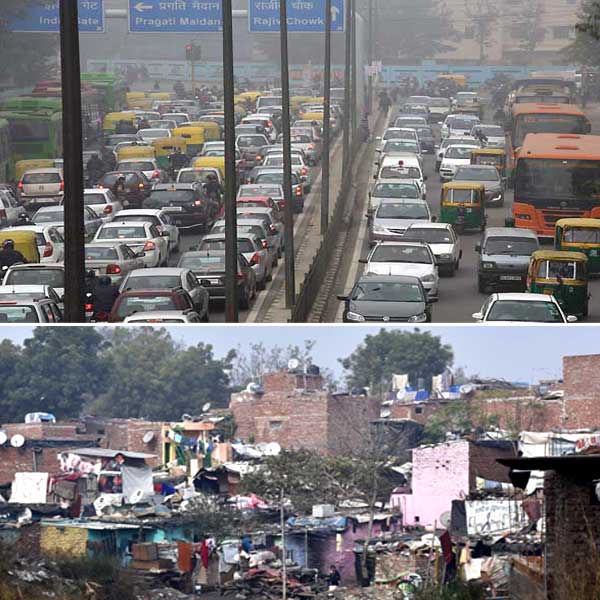
Traffic Snarls: Move out on Delhi roads and you are confronted with long queues of motor vehicles that kill the joy of driving beside failing you on your calculations of reaching the destination. Very frustrating to drive a car in Delhi. This leads to road rage, burning of petrol, travel delays and air pollution.

The chief minister will have to restrict the entry of newer vehicles on the roads of Delhi and for this he will have to check corruption which lets free flow of  black money in the society. While a lot of black money is spent in buying vehicles it is also 'burnt' in fuels because there is no check on its purchase.
Solution:
* Restrict the number of cars a person can buy.
* New car can be purchased once in five years only. 
* Levy parking charges on vehicles parked on public roads/ lanes

Slums of Delhi: Delhi often faces criticism for its slums. Political parties have taken undue advantage of these slums by influencing people living there. Spread in large areas these omnipresent slums also pose serious health problems and hygiene issues for its dwellers. It is also a difficult task for the administration to manage civic amenities in these colonies. 

The chief minister can conduct a study to find out if regular township could be built in slum areas on the same piece of land. Thus people living here would be able to shift to  multi-storey smaller EWS apartments, to be constructed by Delhi Development Authority (DDA). This will give them a better living, more security and improved hygiene in a planned society without dislocating them. This will save lot of land that is occupied by slum dwellers at present. 

Pollution: Delhi is in the grip of severe pollution. Take a trip to the city and you will see people moving around with their faces covered with masks. A disheartening scenario ! Though the chief minister has promised to adopt measures to bring down the pollution level he will have to take drastic and harsh steps in this direction. Water, air and noise pollutions are certainly bane for any civilised society.

Kejriwal shot into limelight with his Odd-Even scheme of vehicles to control air pollution. Though he himself praises the scheme and counts its benefits it has, practically, not been beneficial at all. Implementing the scheme for mere 15 days cannot yield any result and that people of Delhi came out smarter. They bought different vehicles bearing odd and even numbers.
Solution: To my mind, it will be better to have similar scheme in a different way. No such vehicle to be allowed on road if the last number of registration number matches with the same date. This means if the number of vehicle is 1234 then it will not ply on road on 04th, 14th and 24the of the month. Now it is immaterial whether you have vehicle with odd number or even number because every vehicle will stay indoors at least three days in a month. And this not too much for asking.

Waste Management: Garbage is yet another major problem that is faced by metropolitan cities and Delhi is no exception. Kejriwal will have to encourage Waste Management Plants so that waste can be used in a more constructive way. Utilising plastic is a bigger challenge in this direction and we can take case studies from developed countries on this issue.

Flooding of roads: Come monsoon and the Delhi roads are deluged in rainwater. The phenomenon repeats itself every year, lots of breaking news on TV channels puts the administration to shame but the whole episode is forgotten as soon as the rains are over. The chief minister will have to look into the issue of rainwater, see how to utilise it and cleaning of the drains.
Suggestion: Would it be possible to recharge fast depleting underground water table with rainwater ?  Are we well utilising the rainwater that the streets of Delhi receive in huge quantity regularly every year ? 

Public Libraries/ Museums: A city earns reputation with quality education and amusement facilities it offers to the public. While the AAP government has many claims in improving the education in government schools it has yet to a come up with a couple of decent public libraries. Who can better understand the importance of a library than Kejriwal himself who himself is an alumni of IIT and successfully cracked civil services examination !

Delhi organises book fairs regularly which are visited by millions of admirers. This shows that how much 'book hungry' the people of Delhi are ! One would like to see the Delhi government coming up with public libraries, no matter if they offer paid membership.

Similarly the Delhi government should also plan a grand museum in the national capital. This will make the city an international destination, provide amusement facility to people and bring revenues to the government.

KEJRIWAL, A CHALLENGER
It is easy to expect from the chief minister who has proved to the people that he is in office just for one cause-- bring about positive changes in the administration, public life and cleaner politics. Kejriwal has given wings to the people's expectations without any greed or discrimination. This makes him a bigger challenger to other veterans as people have started seeing him as a role model now. 

Indian politics has seen a revolution of sorts in the last few years when Narendra Modi emerged as the messiah of hopes and aspirations of people. Modi got huge mandate as he came with heart winning speeches and real-life promises. While the entire country was in the grip of 'Modi Wave' here comes another challenger whose name is Arvind Kejriwal. Modi made a magical effect in Indian politics but Kejriwal has set a new benchmark for all other politicians who dream big.

We have seen Modi-Kejriwal tussle in the past but as of now we hope to get the best from Modi at national level and Kejriwal at state level. Both the leaders are like a 'soldiers in offices'-- people sleep with peace in their homes while they work.

**************************

NOTE

Also read my other pieces:
Copy/ Paste the given links to read these Blogs. 

1) हवा ही है ज़हरीली (2019)
http://apurvarai.blogspot.com/2019/12/blog-post.html 

2) अब दिल्ली महानगरपालिका चुनाव (2017)
http://apurvarai.blogspot.com/2017/04/blog-post.html

3) Monsoon and Delhi Roads (2017)
https://apurvaopinion.blogspot.com/2017/07/monsoon-and-delhi-roads.html


4) Delhi Fights Pollution: Odds Come Again (2016)
https://apurvaopinion.blogspot.com/2016/04/delhi-fights-pollution-odds-come-again.html

5) Delhi Pollution: Fighting Odds to make Things Even (2016)
https://apurvaopinion.blogspot.com/2016/01/delhi-pollution-fighting-odds-to-make.html

6) Delhi Pollution- Check 'Green Agenda' of Builders (2015)
https://apurvaopinion.blogspot.com/2015/07/delhi-pollution-time-to-check-green.html


7) Delhi Pollution: Mindless Driving Major Concern (2015)
https://apurvaopinion.blogspot.com/2015/07/mindless-driving-polluting-delhi.html

8) मैं और मेरी दिल्ली (2011)
http://apurvarai.blogspot.com/2011/11/blog-post.html