
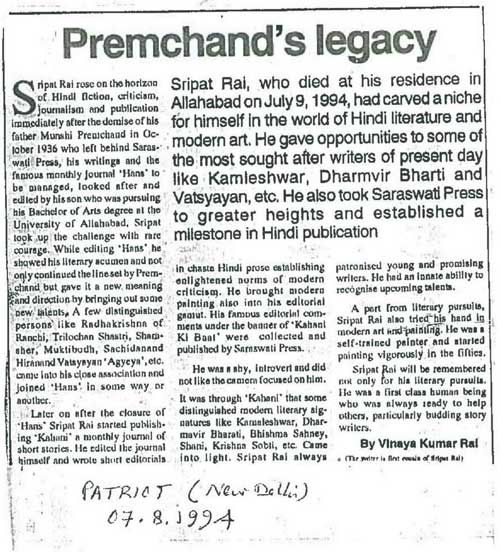
Sripat Rai, who died at his residence in Allahabad
on July 9, 1994, had carved a niche for himself in the world of Hindi
literature and modern art. He gave opportunities to some of the most sought
after writers of present day like Kamleshwar, Dharmvir Bharti and Vatsyayan,
etc. He also took Saraswati Press greater heights and established a milestone in
Hindi publication.
By Vinaya Kumar Rai
By Vinaya Kumar Rai
 SRIPAT Rai rose on the horizon of Hindi fiction,
criticism, journalism and publication immediately after the
demise of his father Munshi Premchand in October 1936 who left behind Saraswati
Press, his writings and the famous monthly journal 'Hans' to be managed, looked
after and edited by his son who was pursuing his Bachelor of Arts at the
University of Allahabad, Sripat took up the challenge with rare courage.
SRIPAT Rai rose on the horizon of Hindi fiction,
criticism, journalism and publication immediately after the
demise of his father Munshi Premchand in October 1936 who left behind Saraswati
Press, his writings and the famous monthly journal 'Hans' to be managed, looked
after and edited by his son who was pursuing his Bachelor of Arts at the
University of Allahabad, Sripat took up the challenge with rare courage.
While editing 'Hans'
he showed his literary acumen and not only continued the line set by Premchand
but gave it a new meaning and direction by bringing out some new talents. A few
distinguished persons like Radhakrishnan of Ranchi, Trilochan Shastri,
Shamsher, Muktibodh, Sachidanand Hiranand Vatsyayan 'Agyeya' etc came into his
close association and joined 'Hans' in some way or the other.
 Later on after the closure of 'Hans' Sripat Rai
started publishing 'Kahani', monthly journal of short stories. He edited
the journal himself and wrote short editorials in chaste Hindi prose
establishing enlightened norms of modern criticism. He brought modern painting
also into his editorial gamut. His famous editorial comments under the banner 'Kahani
ki Baat' were collected and published by Saraswati Press.
Later on after the closure of 'Hans' Sripat Rai
started publishing 'Kahani', monthly journal of short stories. He edited
the journal himself and wrote short editorials in chaste Hindi prose
establishing enlightened norms of modern criticism. He brought modern painting
also into his editorial gamut. His famous editorial comments under the banner 'Kahani
ki Baat' were collected and published by Saraswati Press.
He was shy, introvert and did not like camera
focused on him.
 It was through 'Kahani' that some
distinguished modern literary signatures like Kamleshwar, Dharmavir Bharati,
Bhishm Sahney, Shani, Krishna Sobti etc came into light. Sripat always
patronised young and promising writers. He had an intense ability to recognise
upcoming talents.
It was through 'Kahani' that some
distinguished modern literary signatures like Kamleshwar, Dharmavir Bharati,
Bhishm Sahney, Shani, Krishna Sobti etc came into light. Sripat always
patronised young and promising writers. He had an intense ability to recognise
upcoming talents.Apart from literary pursuits Sripat Rai also tried his hand in modern art and painting. He was a self-trained painter and started painting vigorously in the fifties.
Sripat Rai will be remembered not only for his literary pursuits. He was a first class human being who was always ready to help others, particularly budding story writers.
(The author is a first cousin of Sripat Rai)
This
article was written by my father on August 7, 1994 for the national
English daily 'Patriot' where I worked on the General Newsdesk.

Note: The author and my father Vinaya Kumar Rai was not only first cousin of Sripat Rai but was close to his heart too for over six decades. Both the brothers, known as Dillan (Vinaya Kumar Rai) and Dhunnu (Sripat Rai) lived in Delhi and spent happy times together for nearly five decades. My father, who lived in 30/18 Shakti Nagar area of north Delhi and later D-21, Sector-12 NOIDA- 201301 would often visit Mama who lived in R-7 Hauz Khas locality of south Delhi.
I am privileged to have spent my childhood days under Mama's patronage and love. I remember him as a reserved person with distinguished style and personality. One needed a sixth sense to understand Mama and fortunately Papa had it and that is what brought both the brothers together and kept them close till God's will.
Mama was just a graduate as far educational qualification goes but proved that knowledge and ability is not confined to degrees only. Education means much more than a degree and Sripat Rai aptly proved it in his lifetime. He had superb command over various languages. Besides Hindi and English he spoke Urdu and Bengali with great ease. He also admired good music and was particularly fond of Rabindra Sangeet. I remember seeing him playing records on his gramophone and listening to the Rabindra Sangeet with his eyes closed.
He was a man of ethics, morality, fine taste and simplicity but was also known for exquisite choices be it his lifestyle, dressings, food or much more.
--Apurva Rai
NOTE
This article has also been translated in Hindi by Apurva Rai and published in the Hindi magazine 'Lamahi' edited by Vijay Rai.

To read Hindi version copy/paste the following link:
https://apurvarai.blogspot.in/2018/05/blog-post.html
NOTE
This article has also been translated in Hindi by Apurva Rai and published in the Hindi magazine 'Lamahi' edited by Vijay Rai.

To read Hindi version copy/paste the following link:
https://apurvarai.blogspot.in/2018/05/blog-post.html

